Subscribe to our exclusive email list and unlock actionable tips and strategies gleaned from our own successes.
Why High Traffic Doesn’t Equal High Revenue In SEO
Traffic growth can feel reassuring.
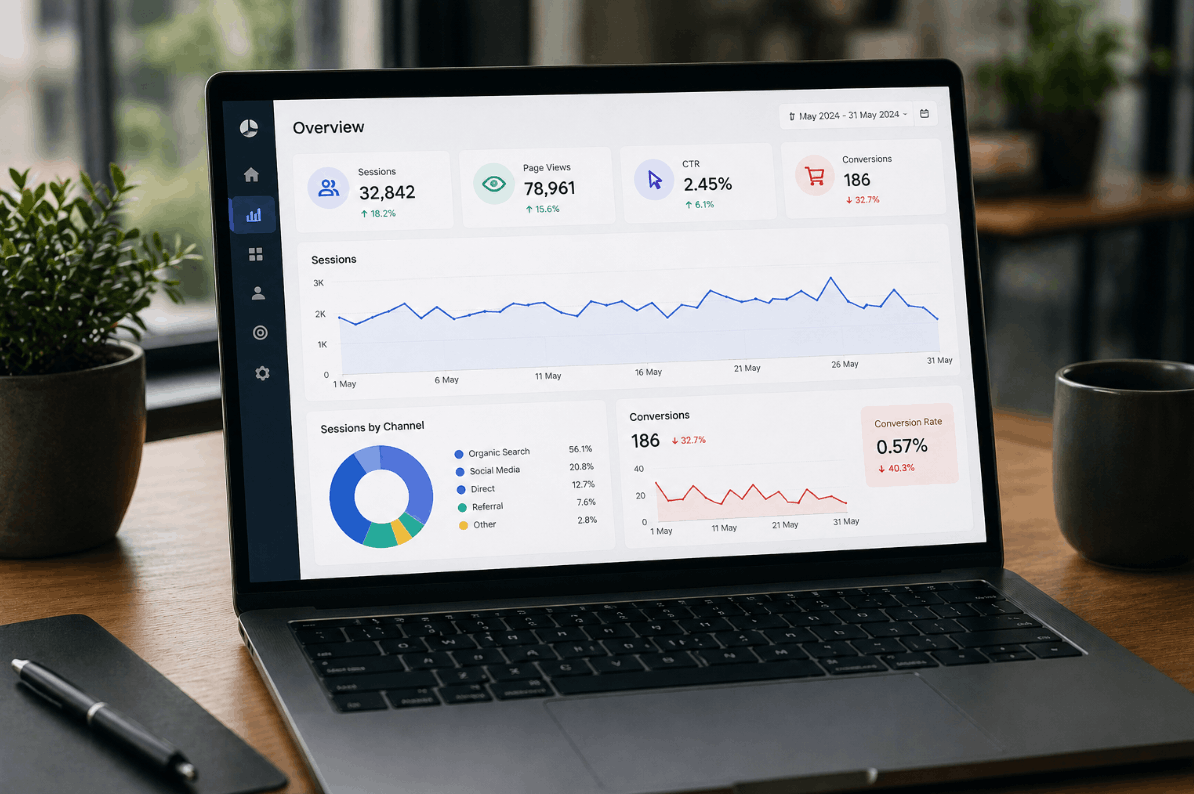
You log into Search Console, the graphs are heading upwards, and suddenly, SEO looks like it is doing exactly what it should.
Until someone asks where the enquiries are.
That is usually the moment the conversation changes.
Because traffic, on its own, is not the goal.
A business does not grow because more people landed on a website. It grows when the right people arrive, find what they need and actually take action.
That is where a lot of SEO strategies lose their way.
They focus heavily on visibility because visibility is easy to measure. Revenue is harder. Lead quality takes more thought. Commercial performance requires a proper strategy.
But if SEO is not contributing to growth, what exactly are we measuring?
Not all traffic is worth chasing
A lot of businesses are told that more traffic means SEO is working.
Sometimes that is true.
Sometimes it really is not.
A blog attracting thousands of visitors each month might look like a success. If those visitors were never likely to become customers in the first place, it is not doing much for the business.
That does not mean informational content has no value. It can absolutely help build awareness and trust, especially earlier in the buying journey. The problem comes when that is all your SEO strategy is doing.
But if the goal is revenue, then intent matters far more.
High intent keywords bring in users who are actively looking for a provider, comparing options or moving closer to making a decision.
The traffic volume may be lower.
That is not necessarily a problem.
Better traffic beats bigger traffic every time.
That is the foundation of a proper SEO revenue strategy.
Why SEO traffic often fails to convert
Usually, the issue is not SEO itself.
It is how the strategy has been approached.
One of the most common problems is keyword intent.
If the website is attracting people who are researching casually rather than looking for a solution, traffic can grow without any real commercial impact.
Then there is landing page alignment.
If someone clicks through expecting one thing and lands somewhere vague, generic or disconnected from their search, they leave.
That is not a traffic problem. That is an experience problem.
Calls to action can create the same issue.
If the next step feels unclear or unnecessarily difficult, even interested users drift away.
Internal linking structure matters too.
Some websites do a decent job of attracting traffic into blogs or resource content, but there is no obvious route towards a relevant service page. Users arrive, consume the content, then disappear.
And yes, technical issues still play a part.
A slow mobile experience or a frustrating enquiry form can quietly kill conversion performance.
How to diagnose what is actually going wrong
This is where businesses often focus on the wrong data.
Traffic tells part of the story, but not enough of it.
Start with landing page performance.
Look at where organic traffic is entering the site. Then compare that with what those pages actually contribute.
Some pages may attract attention but deliver very little commercially.
Others might bring in fewer visitors but consistently generate enquiries.
That tells you far more than raw session numbers ever will.
Assisted conversions matter as well.
Not every page is supposed to convert directly. Some pages support the wider journey. Someone may discover your business through an informational blog, leave, then return later through a service page and convert.
That still counts.
Search Console can also be useful here.
If pages are generating impressions but nobody is clicking, messaging may need work.
If users are clicking through but not converting, the issue is likely what happens after they land.
Shifting towards revenue-focused SEO
This is usually where the strategy needs to change.
Instead of asking how to drive more traffic, the better question is how to attract traffic that is actually more likely to convert.
That often means putting more focus on high intent keywords tied to commercial services.
It means improving landing page relevance so users get exactly what they expected.
It means reviewing calls to action, removing friction and treating conversion rate optimisation as part of the SEO conversation.
Because if the website experience is weak, simply adding more traffic rarely fixes anything.
What should you actually measure?
Traffic still matters.
It is just not enough on its own.
If SEO is supposed to support growth, then the reporting should reflect that.
Conversion rate matters.
Lead quality matters.
Revenue contribution matters.
Cost per acquisition can be useful too, particularly when comparing channels.
These are the numbers that help businesses make better decisions.
Because a healthy-looking traffic report means very little if sales teams are still asking where the leads are.
A practical way to reset your strategy
If SEO performance feels disconnected from commercial outcomes, start with a reality check.
Review your highest traffic landing pages and assess what they actually contribute.
Look at keyword intent.
Check whether the landing experience matches what users searched for.
Follow the user journey through the website and see where people are dropping off.
Then prioritise the areas most likely to improve commercial performance first.
Not everything needs rebuilding.
Sometimes the issue is surprisingly fixable.
How we approach SEO at Altitude
We are not interested in chasing traffic for the sake of a nicer report.
SEO should contribute to growth.
That means understanding commercial intent, reviewing the actual customer journey and being honest about what is or is not working.
Sometimes that means challenging assumptions.
Sometimes it means moving away from strategies that look busy but deliver very little.
We would rather have a more commercially useful conversation than celebrate traffic that is going nowhere.
Frequently Asked Questions
What are high intent keywords?
These are searches made by people who are actively looking for a solution, service or provider rather than researching casually.
Why is my SEO traffic not converting?
Usually because of poor keyword targeting, weak landing page alignment, unclear calls to action or friction in the website experience.
What is a good SEO conversion rate?
That depends on your sector, audience and offer. Commercial improvement matters more than chasing generic benchmarks.
How do I measure SEO revenue?
Track conversions properly, assign commercial value where possible and connect organic performance back to business outcomes.
Ready to make SEO work properly?
If your traffic is growing but commercial performance is standing still, the issue may not be visibility.
It may be the strategy underneath it.
Get in touch with Altitude to build an SEO strategy focused on meaningful growth.
Here goes the form from your email marketing software.
By clicking “Accept All Cookies”, you agree to the storing of cookies on your device to enhance site navigation, analyze site usage, and assist in our marketing efforts. View our Privacy Policy for more information.






.svg)






%20(1).png)
%20(1).png)